
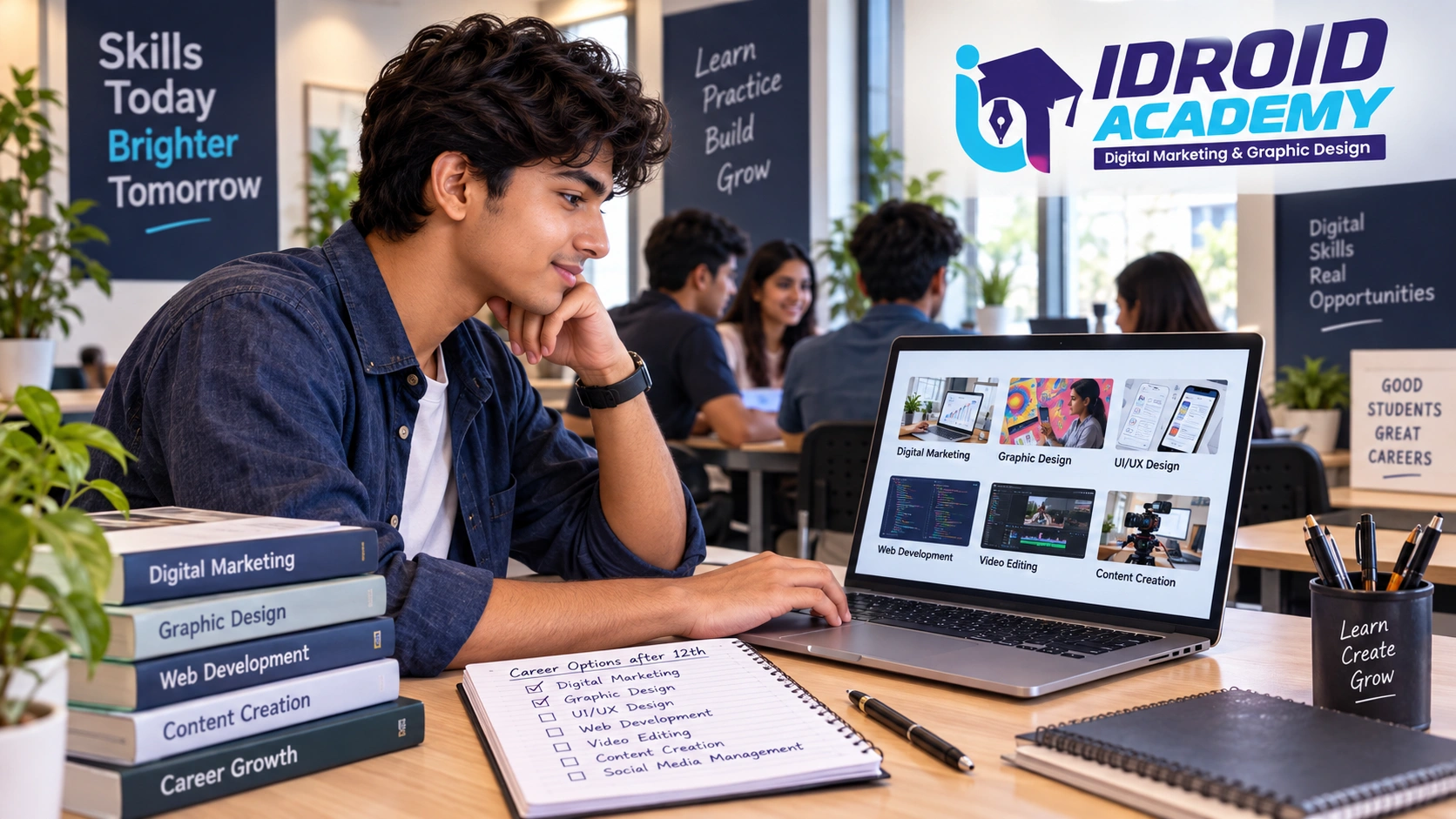
The pressure to pick "the right path" right after 12th is real, and a four-year degree is not the only route into a good career anymore. Skill-based digital courses have become a genuine alternative, especially in fields where employers care more about a portfolio and hands-on ability than a specific degree. Here is a grounded look at what to do after 12th if you are considering this route, and which digital skills are actually worth learning in 2026.
What to Do After 12th If You Want a Skill-Based Career
Right after 12th, you generally have three broad paths: a traditional degree, a professional or technical degree, or a shorter, focused skill course that gets you job-ready faster. None of these is automatically the "correct" one, it depends on what kind of work you want to do. If you are drawn to creative or digital fields, design, marketing, content, or social media, a focused skill course can get you into the workforce in a matter of months rather than years, provided the course is genuinely practical and not just theory delivered on a certificate.
The honest tradeoff is that a skill course works best when you already have a rough sense of the field you want to enter. If you are still completely undecided, spending a little time exploring different digital skills, through free tutorials, internships, or a short exploratory course, before committing to a longer program is a reasonable step.
Why Digital Skills Are Among the Best Courses for Future Jobs
This is not just a vibe. The World Economic Forum's Future of Jobs Report 2025, based on data from over 1,000 global employers, lists UI and UX designers among the top ten fastest-growing job roles worldwide through 2030, alongside roles like big data specialists and software developers. The same report found that skills in AI and big data are expected to grow in demand by roughly 87 percent over this period, with networks and cybersecurity, and creative thinking, following close behind.
Closer to home, LinkedIn's Skills on the Rise 2026 report for India points to a similar shift specifically within marketing roles: the fastest-growing skills employers are hiring for include prompt engineering, visual storytelling, performance analysis, collaboration, and creative thinking. In other words, the marketing and design jobs that are growing fastest right now are not asking for theoretical knowledge alone, they are asking for people who can actually create content, read campaign data, and adapt quickly, exactly the kind of practical ability a hands-on course is built to teach.
Trending Courses in 2026 Worth Considering
Based on where hiring demand is actually heading, here are the digital skill areas worth a serious look after 12th:
Digital Marketing. Covers SEO, Google Ads and PPC, social media marketing, content marketing, email marketing, and analytics, essentially the full toolkit behind how businesses get found and get customers online. It remains one of the broadest entry points into a digital career because it touches almost every other skill on this list.
Graphic Design. Visual storytelling was specifically named in LinkedIn's 2026 India data as one of the fastest-growing marketing skills, and graphic design is the foundation of that ability, using tools like Photoshop and Illustrator to create the visuals brands actually run with.
UI/UX Design. Given WEF's data placing UI/UX designers among the ten fastest-growing job roles globally, this is one of the more evidence-backed choices on this list, especially for anyone who enjoys a mix of visual design and problem-solving around how people actually use a product.
Social Media Marketing. A dedicated specialization within digital marketing, covering platform strategy, content planning, paid ads on Meta, and community management, for anyone who wants to focus specifically on brand presence on Instagram, Facebook, and LinkedIn.
SEO Specialist. A focused path into ranking websites organically, on-page, off-page, and technical SEO, for people who enjoy the more analytical, research-driven side of digital marketing.
Content Creator. Covers writing, video, and editing skills for people who want to build content professionally, whether for brands, agencies, or their own channels.
Video Editing. A production-focused skill that pairs well with content creation and social media work, given how much current marketing runs on short-form video.
You can browse the full breakdown of these programs, along with duration and curriculum details, on iDroid Academy's all courses page.
How to Choose the Right Course After 12th
A few honest questions help narrow this down faster than endlessly researching "best course for future jobs" lists:
Do you enjoy visual work or analytical work more? Graphic design and UI/UX lean visual and design-driven. SEO and digital marketing analytics lean more toward research and numbers. Most people have a natural pull toward one side.
Do you want to specialize early or stay broad? A full Digital Marketing course keeps your options open across SEO, ads, and social media. A specialization like UI/UX or Social Media Marketing narrows your focus faster but can also make you more competitive for that specific role sooner.
How much of the course is actually hands-on? A course that only covers theory through slides will leave you underprepared compared to one where you are running real campaigns, designing real interfaces, or managing real social accounts before you graduate.
What a Practical, Placement-Focused Course Should Include
Whatever course you pick, a few things separate genuinely useful training from a certificate that looks good but does not translate into a job:
- Live, client-style projects, not just recorded lessons, so you graduate with actual work to show, not just a completion certificate.
- Portfolio and resume building built into the course itself, since most hiring in design and marketing roles starts with reviewing actual work.
- Interview preparation and soft skills training, which matters as much as the technical skill itself in landing the first role.
- Real placement support, meaning industry connections and referrals, not just a vague promise of "career guidance."
iDroid Academy's courses are structured around exactly this approach, with live projects across Digital Marketing, Graphic Design, Social Media Marketing, SEO, UI/UX Design, Content Creation, and Video Editing, backed by resume building, mock interviews, and access to the academy's industry and alumni network. You can see how this plays out for past students on the placement support page.
Frequently Asked Questions
Is a skill course a good alternative to a college degree after 12th? It depends on the field. For design, marketing, content, and similar digital roles, employers increasingly care about a working portfolio and demonstrated skill, which a focused, practical course can provide faster than a traditional degree.
Which digital course has the best job scope right now? Based on current global and India-specific hiring data, UI/UX design, digital marketing, and social media marketing all show strong demand, though the "best" choice depends on whether you are more drawn to visual design or to marketing and content work.
Can I do a digital skills course while still in college? Yes. Most of these courses run for a few months with a couple of hours of daily classes, which makes it possible to pursue one alongside a degree if you want both.
Do these courses guarantee a job? No legitimate course can guarantee a job outright. What a genuinely good program can offer is placement support, real project experience, and industry connections that meaningfully improve your chances.
Explore the Right Course for You
If you are still deciding what to do after 12th, browsing iDroid Academy's full range of courses is a reasonable starting point to compare options side by side. You can call the academy at +91 9589674037, write to info@idroidacademy.com, or book a free demo session to talk through which path actually fits your interests.