
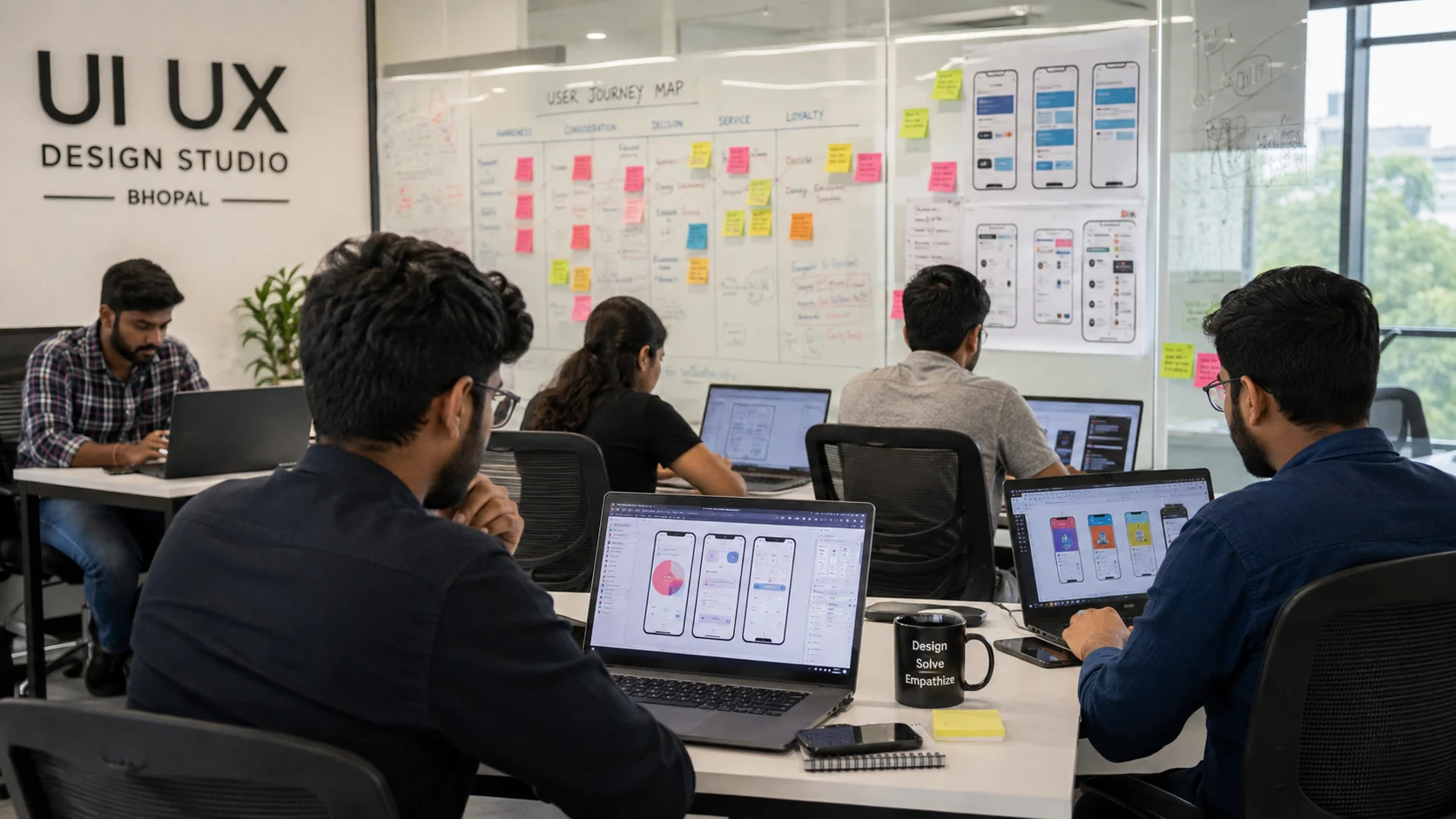
Every app you open and every website you use has someone behind the decisions that made it easy, or frustrating, to use. That someone is a UI/UX designer, and it's one of the few creative skills right now where demand is genuinely outpacing the number of people trained well enough to do it properly. If you've been searching "UI UX design course in Bhopal" or even just "UI UX coaching near me," this guide answers what you actually need to know before choosing one.
What UI and UX actually mean, in plain terms
These two get used together so often that people assume they're the same thing. They're related, but different.
UI, user interface, is what something looks like. The layout, the colors, the buttons, the typography, the visual polish that makes a screen feel put together.
UX, user experience, is how something works. Whether a user can complete a task without getting confused, whether the flow from one screen to the next makes sense, whether the whole experience feels smooth or like a fight.
A good UI/UX designer thinks about both. A screen can look beautiful and still fail if users can't figure out where to tap next. It can also work perfectly and still lose users if it looks outdated or cluttered. The best course, and the best designers, treat these as one connected skill, not two separate ones.
Why this is worth learning right now
Every startup building an app needs this. Every business redesigning its website needs this. E commerce platforms, ed tech companies, healthcare apps, banking apps, and even government portals are all investing in better design because users simply leave faster when an experience feels clunky. That shift has made UI/UX one of the more consistently in demand skills across the country, not just in major tech cities.
Bhopal itself now has a growing number of startups and small tech teams that need this skill locally, along with remote opportunities that don't require relocating to Bangalore or Delhi at all. That combination, real local demand plus remote work potential, is part of what makes this course worth serious consideration.
What a proper UI/UX design course should actually teach
A lot of institutes reduce this course to "learn Figma," which is a bit like reducing cooking to "learn how to use a knife." Here's what a complete course actually needs to cover.
Design Thinking Understanding the problem before jumping into screens. Empathizing with the user, defining the actual problem, and only then moving toward solutions. Skipping this step is exactly why so many apps end up solving problems users never had.
User Research Interviews, surveys, and understanding real user behavior instead of guessing what people want. This is often the most skipped part of weaker courses, and it's the part that separates a designer who can justify their decisions from one who's just following trends.
Wireframing Building the basic skeleton of screens before adding any visual design, so the structure and flow get tested before time gets spent on polish.
Prototyping Turning wireframes into clickable, testable versions of a product using tools like Figma, so flows can be validated before a single line of code gets written.
Visual Design (UI) Typography, color theory, spacing, and layout systems, this is where the interface actually starts looking finished and professional.
Usability Testing Watching real users try to use a design and finding out where they get stuck, rather than assuming a design works just because it looks clean.
Design Systems Understanding how to build reusable components and consistent patterns, which is exactly what real product teams expect from anyone joining them.
Figma The industry standard tool right now for UI/UX work, covering everything from wireframes to interactive prototypes to handoff for developers.
Adobe XD Still used across several teams and worth knowing even as Figma has become the dominant tool.
Portfolio and Case Study Building This is what actually gets you hired. Companies hiring UI/UX designers care far more about a well documented case study showing your thinking than a certificate confirming you attended a course.
If a course skips user research, usability testing, or portfolio building, you're getting a UI course with a UX label on it, not the real thing.
How long should a UI/UX design course take
For a program that genuinely covers design thinking, research, wireframing, prototyping, and a complete portfolio, expect somewhere between three and five months for a full time or intensive format, and longer if you're learning part time alongside a job or college.
Be cautious of anything promising job readiness in a few weeks. Figma itself can be learned quickly. Understanding how to research a problem, structure a flow, and defend your design decisions in an interview takes real practice, not just tool familiarity.
What does a UI/UX design course cost in Bhopal
Fees typically range from around twenty thousand to fifty thousand rupees for a complete course covering research, wireframing, prototyping, visual design, and a full portfolio of case studies. Courses on the lower end usually cover Figma basics and visual design alone, without meaningful research or usability testing components. Courses toward the higher end tend to include smaller batches, dedicated mentorship on case studies, and more one on one feedback.
Rather than comparing purely on fees, ask exactly what's included, and specifically whether the course results in real, presentable case studies you can show in an interview or to a client. That's ultimately what gets you hired, not the number of hours logged in class.
Career scope after a UI/UX design course
UI/UX Designer at a company or startup The most direct path, working on an in house product team or with an agency serving multiple clients. Entry level roles in Bhopal and similar cities typically start in a reasonable range and grow quickly with a strong portfolio, since this remains a skill in shorter supply than demand.
Remote work with companies outside Bhopal UI/UX is one of the more remote friendly creative skills available right now. A strong portfolio can open up opportunities with companies based anywhere in the country, or internationally, without needing to relocate.
Freelancing Many trained designers take on independent projects for startups and small businesses through referrals and platforms like Upwork. Freelance UI/UX work tends to pay well per project once you have a few solid case studies to show.
Product Designer A natural next step for UI/UX designers who develop a strong sense of both design and product thinking, often involving closer collaboration with product managers and developers, and typically better compensation as a result.
Specializing further Some designers move deeper into specific lanes such as design systems, motion design for interfaces, or UX research as a dedicated role, once the fundamentals are solid.
The honest takeaway is that Figma skill alone gets you a portfolio piece. Understanding how users actually think and behave is what gets you hired, and keeps you relevant as tools change over time.
How to choose the right UI/UX design institute in Bhopal
- Ask to see real student case studies, not just polished mockups pulled from tutorials.
- Check whether the course includes actual user research and usability testing, not just visual design.
- Find out who's teaching. Someone who has worked on real products teaches this very differently than someone teaching Figma shortcuts alone.
- Ask what portfolio support looks like. A collection of practice screens is not the same as documented, presentable case studies.
- Sit in on a demo class before enrolling. Any serious institute will be comfortable with this.
If you're searching "UI UX coaching near me" specifically because you want something local rather than an online only program, prioritize institutes where you can actually sit with a mentor and get feedback in person. UI/UX is a skill that improves fastest through direct, specific critique, and that's harder to replicate well over a screen.
UI/UX design training at iDroid Academy
At iDroid Academy, the UI/UX course is structured around the idea that design decisions should be explainable, not just visually pleasing. Students start with design thinking and user research, move through wireframing and prototyping in Figma, and finish with visual design and usability testing, so every decision in the final portfolio has a reason behind it that can hold up in an interview.
Every project is built as a real, presentable case study rather than an isolated exercise, and batches are kept small so feedback on design decisions stays specific and personal. Because UI/UX and graphic design share a real foundation in composition, typography, and color, students often benefit from also exploring the Graphic Design course alongside or before this one, particularly if visual fundamentals need strengthening first.
Once the course wraps up, there's structured support in place, including portfolio reviews, mock interviews, and direct introductions through the institute's industry connections. Students join from across Bhopal, MP Nagar, Arera Colony, Kolar Road, Habibganj, and nearby towns like Sehore and Vidisha, thanks to the institute's easy to reach location in MP Nagar Zone 1.
If you want the full breakdown of modules, tools, batch timings, and fees, the UI/UX Design Course page has everything laid out. And if you'd rather see how a class actually runs before committing, you're welcome to walk in for a free demo, no pressure either way.
A last thought before you decide
Good design is invisible when it works and painfully obvious when it doesn't. That's exactly why UI/UX is such a valuable skill to build properly rather than rushed through. Choose a course that teaches you to understand users, not just to arrange pixels neatly, and the career opportunities that follow will take care of themselves.